Bradypus variegatus is one of just a handful of extant sloth species. The three-toed sloth, as it is commonly called, has small eyes, unnoticeable ears, and forelimbs that are about one and a half times longer then its hind limbs, giving this mammal a comic appeal. The short, blunt tail, which according to Nowak (1991) resembles 'an amputated limb,' can only add to this species' curious appearance. Adults generally reach a length of 413 to 700 mm and attain weights between 2.25 and 5.5 kg (Nowak, 1991).
The coat of Bradypus consists of two types of hair, the first a short fine fur and the other long, thick guard hairs that are grooved and appear to encourage algal growth. As with Choloepus, Nowak (1991) suspects that the algae provides camouflage to the sloth as well as nutrients.
Like all living sloths, Bradypus variegatus is noted for its very slow movement and strictly arboreal lifestyle. All daily life activities are carried out while upside down, including eating, sleeping, mating, and giving birth. Only urination and defecation is done on the ground and the sloth needs to descend from the trees just once a week to do so. A sluggish metabolism probably contributes to the lessened elimination needs, and as a result of the same slow, life processes Bradypus, like most other sloths, cannot maintain a constant body temperature (Nowak, 1991). This condition leads to a dependence on a consistently warm habitat such as is found in the tropical forests of Honduras to northern Argentina, where B. variegatus lives (Nowak, 1991).
Overall, species in the genus Bradypus tend to be less active then the ecologically similar two-toed sloth. Individuals rarely even cross over to a neighboring tree in the course of one day, preferring to move less than a few meters (Nowak, 1991). Bradypus variegatus is a more specialized forager than Choloepus hoffmanni, feeding almost exclusively on twigs and leaves from Cecropia trees (Nowak, 1991). In addition, three-toed sloths are less social than other species, preferring to feed, sleep, and travel alone rather than in groups. Males and females probably only pair for mating, and a one to one sex ratio has been observed in the wild (Nowak, 1991). There is usually only a single young after a gestation period of 5-6 months, and while the offspring will no longer nurse after about one month, it still relies on its mother for another five (Nowak, 1991).
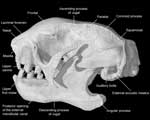
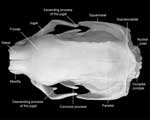
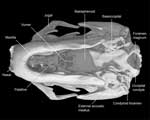
Species of Bradypus belong to Bradypodidae, which at one time included Choloepus, but is now restricted to three-toed sloths. This clade can be diagnosed by cranial characteristics, including a short rostrum, dorso-ventrally flattened skull, tympanic bullae, mandibles with conspicuous coronoid processes, a jugal ending posteriorly in long, flared ventral and dorsal processes, and a condyloid process that is longer than it is wide. Additionally, the pterygoids do not meet at the midline (Anderson and Jones, 1984). The simple, peg-like teeth are very similar in structure to those of the family Megalonychidae (two-toed sloths and ground sloths) in that they are composed of a central core of vasodentine that is wrapped by a thin layer of dentine and then a thick outer layer of cement (Anderson and Jones, 1984). The teeth are also continuously growing. In contrast to megalonychids, bradypodids have very small or even absent anterior maxillary teeth (caniniforms) and when present, there is no gap separating them from molariform elements (Anderson and Jones, 1984). The dental formula is 5/4.
Post-cranial characteristics of Bradypus include hands and feet with three toes each, the digits tightly bound up until the strongly recurved claws, 18-27 thoracolumbar vertebrae, and 8 or 9 cervical vertebrae (Anderson and Jones, 1984). They also lack a third trochanter and entepicondylar foramen. The extra cervical vertebrae give Bradypus increased flexibility, allowing the sloth to turn its head 270 degrees, or nearly three-quarters of the way around!
Additional Information on the Skull
Click on the thumbnails below for labeled images of the skull in standard anatomical views.

Literature
Anderson, S. and J. K. Jones, Jr. 1984. Orders and Families of Recent Mammals of the World. John Wiley and Sons, New York. 686pp.
Nowak, R. 1991. Walker's Mammals of the World, 5th edition. The John's Hopkins University Press, Baltimore and London. 642pp.
Links
Bradypus variegatus page on the Animal Diversity Web (University of Michigan Museum of Zoology)
Bradypus page on Xenarthra.org
The Sloth Web Site
Bradypus bibliography on Sloth-World.org


 )


)